

Why are you still paying a monthly fee to a middleman who won't show you their work? It’s exhausting to feel like your financial freedom is locked inside a black box. You likely already know that 37% of credit reports contain errors, yet the traditional path to fixing them often feels like a slow, expensive gamble. You want the inaccuracies gone, but you're tired of the lack of transparency and the fear that a generic dispute will just trigger an automated rejection from the bureaus.
When weighing credit repair software vs agency options in 2026, the landscape has fundamentally shifted. You no longer need to outsource your autonomy to get professional results. This guide explores how AI-powered tools and Metro 2 audit engines give you the leverage to handle your own affairs with total confidence. You will discover the critical differences in cost, speed, and effectiveness so you can reclaim your standing. We look at why the traditional agency model is becoming obsolete and how modern technology finally puts the power back in your hands.
Key Takeaways
- Learn why the traditional agency model is being disrupted by AI tools that give you direct control over your credit report.
- Uncover the "black box" tactics agencies use to prolong your subscription and how software provides total visibility into every dispute.
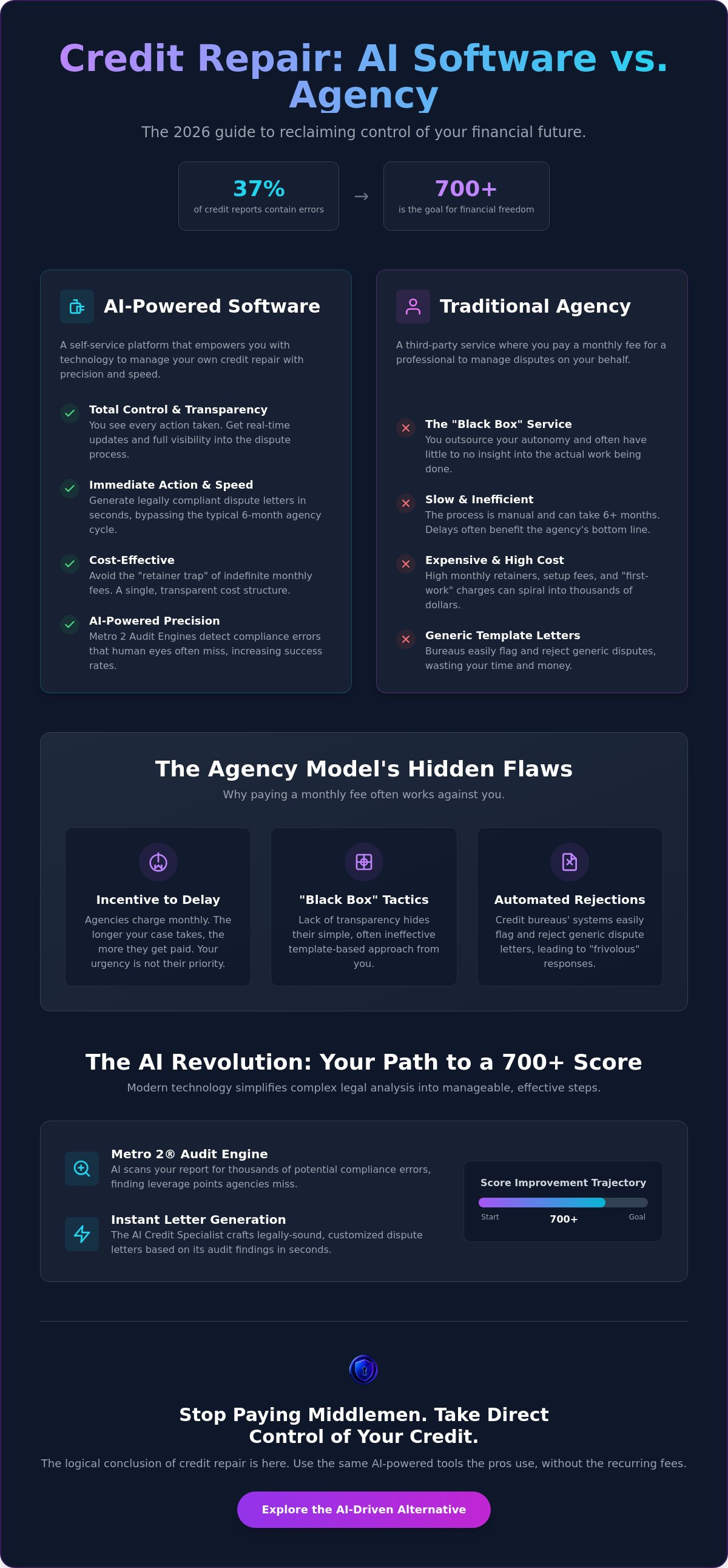
- Compare credit repair software vs agency efficiency to see how automated Metro 2 audits detect compliance errors that human eyes often miss.
- Discover how to bypass the standard six-month agency cycle by generating legally compliant dispute letters in seconds.
- Identify a logical path to a 700+ score using an AI Credit Specialist to simplify complex legal analysis into manageable steps.
The Credit Repair Dilemma: Software vs Agency
You face a pivotal choice between two very different paths to financial recovery. One path is the traditional agency model that has dominated the industry for decades. The other is a modern, AI-powered software solution. This decision defines how much control you retain over your financial future and how quickly you see results. In 2026, the gap between professional capabilities and consumer tools has vanished. AI has democratized the process, allowing individuals to access the same precision tools previously reserved for high-priced firms.
Credit repair software is a self-service platform designed to empower the user. It uses technology, such as a Metro 2 Audit Engine, to scan your credit reports for legal inaccuracies and provides automated dispute letter generation. Conversely, a credit repair agency is a third-party service where you pay a professional to manage these disputes on your behalf. Both models are governed by the Credit Repair Organizations Act (CROA), a federal law that protects you from deceptive practices and ensures you aren't charged for services that haven't been performed.
The core of the credit repair software vs agency debate is a trade-off between speed and convenience. Software offers immediate action and radical transparency. Agencies offer a "hands-off" experience, but this often comes at the cost of visibility and a significantly longer timeline. You aren't just choosing a service; you're choosing whether to be an active participant or a passive observer in your own financial turnaround.
Who is Credit Repair Software For?
This path is built for the person who is tired of waiting for answers. It's for tech-savvy individuals who want real-time updates and total transparency into every dispute sent to the bureaus. If you want to avoid the "retainer trap" of indefinite monthly agency fees, software provides a direct exit. It is particularly effective for those with specific, identifiable errors like late payments, repossessions, or charge-offs that require logical, evidence-based correction rather than generic template letters.
When Does an Agency Make Sense?
An agency might be the right fit if you have zero time and are willing to pay a significant premium for a middleman to handle the paperwork. You are essentially paying for the psychological relief of "outsourcing" your stress. However, you should realize that software does not provide legal representation. If your case is so complex that it requires an attorney to appear in court, a law-firm-based agency is a necessity. For the majority of consumers, an agency is a luxury of convenience that often slows down the actual recovery process.
Decoding the Agency Model: What Are You Actually Paying For?
Understanding the nuances of credit repair software vs agency services begins with looking at the incentives. When you hire an agency, you're often paying for a "black box" service. You send your documents, pay a monthly fee, and wait. The problem is that most agencies don't want you to see the process. If you saw how simple their manual template letters were, you'd realize the high monthly retainer isn't buying expertise. It's buying a middleman who has a financial incentive to keep you enrolled as long as possible. The Consumer Financial Protection Bureau provides resources for individuals to manage and repair their own credit, yet agencies often frame this as a task too complex for the average person.
This incentive misalignment is the industry's quietest secret. Most agencies benefit from taking six months or more to resolve your issues. Because they charge by the month, every delay is a win for their bottom line. They often use generic dispute letters that credit bureaus have seen thousands of times. These templates are easily flagged by automated filters, leading to "frivolous" rejections that waste your time and money. When comparing credit repair software vs agency models, you have to ask if you're paying for results or just paying for a seat in a waiting room.
The real cost is often higher than the advertised monthly rate. Once you factor in setup fees, "first-work" charges, and sometimes even per-deletion bonuses, the total investment can spiral into thousands of dollars. You are paying for a manual process in an era where speed is dictated by algorithms. If you want to see how technology can replace these expensive middlemen, you can explore AI-driven alternatives that prioritize your timeline over a recurring subscription fee.
The Myth of the "Secret" Dispute Method
Agencies frequently claim to have "insider" relationships or proprietary methods for removing items. This is false. Every credit repair action is governed strictly by the Fair Credit Reporting Act (FCRA). No agency has a "backdoor" to the credit bureaus; they use the same laws you have access to. Strict adherence to Metro 2 reporting standards is the only real "secret" to a successful dispute because it forces bureaus to verify data with absolute technical precision.
The Hidden Risks of Outsourcing Your Data
Privacy is a critical concern. When you hire an agency, you hand over your Social Security number and full financial history to third-party employees. You don't always know how securely this data is stored or who has access to it. Generic agencies often flood bureaus with identical disputes, which can get your account flagged as "frivolous." Owning your data through a private software platform is the modern, secure standard for protecting your identity in 2026.
The AI Revolution: How Software Beats the Agency Model
The shift from manual to algorithmic credit repair isn't just a trend. It's a fundamental upgrade in accuracy. While a human at an agency might scan your report for obvious mistakes, an AI-powered system performs a microscopic audit. It looks for technical inconsistencies that the human eye simply misses. This precision is why the credit repair software vs agency debate is leaning heavily toward technology in 2026. You aren't just sending a letter; you're launching a data-driven strike against inaccuracies.
Speed is your greatest asset. Traditional agencies often wait for a specific billing cycle to send your next round of disputes. Software eliminates this artificial delay. You can generate legally compliant letters in seconds. The moment you detect a new error, you can address it. This direct control means you're no longer a passenger in your own financial recovery. You're the driver. You decide what to challenge and when, without waiting for an account manager to return your call.
Metro 2 Compliance: The Professional Advantage
Banks and lenders report your financial data using a specific format called Metro 2. It's a highly complex, standardized code. Basic "not mine" disputes from agencies are often ignored because they don't address the technical validity of the data. A Metro 2 Audit Engine scans for missing fields, incorrect dates, and non-compliant status codes. The Credit Repair Organizations Act protects your right to accurate reporting, but software ensures your challenge is framed in the exact language bureaus use. This technical alignment makes it much harder for bureaus to dismiss your claims as frivolous.
AI Credit Geniuses: Your 24/7 Digital Specialist
Complex credit challenges shouldn't require a law degree or an expensive consultant. AI assistants like Mo act as your digital mentor. Mo analyzes your specific situation and identifies the most effective dispute reason for every unique error on your report. Unlike a human account manager, Mo doesn't have off hours or bad days. You get consistent, logic-based guidance without the burden of hourly fees. This technology simplifies the dispute process into manageable steps, ensuring you always know exactly what to do next. AI identifies the most effective dispute reason for every specific error, removing the guesswork from your strategy.
Decision Framework: Evaluating Your Credit Needs
Choosing between credit repair software vs agency services requires a logical evaluation of your specific situation. You don't need a middleman for every problem. Start by auditing your report. Look for specific inaccuracies like collections, charge-offs, or late payments. If your report contains several of these, you need a system that can handle volume without ballooning costs. A manual audit is the first step toward reclaiming your standing. It reveals the scope of the work ahead and helps you decide if you want to drive the process or watch from the sidelines.
Next, determine your budget. An agency often involves indefinite monthly fees that add up over a year. Software operates on a flexible subscription model, allowing you to pay only for the time you're active. If you need a score boost for a mortgage in 90 days, speed is your priority. Waiting for an agency's monthly cycle could cost you the house. Finally, check for Metro 2 compliance tools and decide on your mailing method. Do you want to handle the post office yourself, or would you prefer a concierge service to do it for you? These technical details often determine the success rate of your disputes.
Cost Comparison: Software vs. Agency
The typical agency lifecycle lasts between six and nine months. During this time, you're locked into a recurring payment regardless of the actual work performed. In contrast, the software subscription strategy allows for surgical precision. You use the platform for the months you need and stop once the errors are removed. For those who want the ease of an agency without the high cost, concierge mailing serves as the perfect bridge. It automates the physical delivery of your dispute letters while you maintain full control of the strategy. This eliminates the "black box" problem while keeping your workload minimal.
Complexity Check: When to DIY
Software is the ideal choice for correcting common errors like inaccurate balances or outdated addresses. These are often the "low-hanging fruit" that provide an immediate score lift. You can use a credit file audit tool to spot hidden errors that agencies often overlook because they rely on generic templates. You can learn more about how to fix credit report mistakes using these advanced tools. If you're ready to stop guessing and start correcting, get started with our Metro 2 audit engine today. You'll find that with the right equipment, the most complex credit hurdles become manageable tasks.
CreditVault.io: The Logical Conclusion of Credit Repair
The credit repair software vs agency debate often feels like a choice between high-cost middlemen and confusing DIY projects. CreditVault.io eliminates that compromise. It represents the intersection of professional-grade power and total consumer autonomy. You don't need to outsource your future when you have access to the same technology used by industry experts. By putting the Metro 2 Audit Engine directly in your hands, the platform removes the "black box" that traditional agencies rely on. You see what the bureaus see. You detect the inaccuracies they hope you'll ignore. This is how you reclaim your standing with total confidence.
At the heart of this system is Mo, your AI Credit Specialist. Mo simplifies the complex dispute process by analyzing your 3-bureau reports and identifying the most effective legal reasons for every challenge. This isn't a generic template generator; it's a sophisticated specialist that works on your schedule. Whether you choose a weekly or monthly subscription plan, you get the same high-level precision. This flexibility ensures you only pay for the time you actually spend repairing your standing. You're no longer locked into a six-month agency cycle that benefits the provider more than the client.
Professional Tools for the Everyday Consumer
Why settle for basic tools when you can use the industry standard? CreditVault.io provides the exact Metro 2 audit logic used by top-tier professionals. This technology is built into the platform, not offered as an expensive add-on. If you want the convenience of an agency without the inflated price tag, the concierge mailing service handles the physical logistics of your letters. We believe in radical transparency. That's why a 3-day free trial is our standard. It's the ultimate move to prove the technology works before you commit to a subscription. You get to see the logic in action before you spend a single dollar.
Reclaiming Your Financial Freedom
True empowerment comes from active participation. When you use AI to fix your own credit, you build a level of confidence that no agency can provide. You aren't just removing a collection or a late payment. You're learning how the financial system actually works. This knowledge is your ultimate leverage for the future. You stop being a victim of an opaque system and start being the lead protagonist in your financial life. Reclaiming your standing shouldn't be a mystery. It should be a series of logical, achievable wins that put you back in control of your 700+ journey.
You have the facts. You understand the costs. Now, it's time to take the most direct path to financial recovery. Start your 3-day free trial with CreditVault.io today and see how precision technology changes everything.
Take Control of Your Financial Narrative
The era of paying high monthly retainers for hidden processes is over. You've learned that the choice between credit repair software vs agency services comes down to one thing: autonomy. By leveraging technology, you bypass the artificial delays of traditional firms and address inaccuracies with technical precision. You now have the framework to audit your own report, identify Metro 2 compliance errors, and execute a strategy that fits your specific timeline.
Precision is your best defense against a complex reporting system. With an AI-driven Metro 2 Audit Engine and legally compliant dispute letter generation, you have the same leverage as a professional firm. If you prefer a hands-off approach to the paperwork, the professional concierge mailing service handles the logistics while you retain full visibility. Join CreditVault and let Mo, our AI Credit Genius, fix your report today. Your path to a 700+ score is clear, logical, and entirely within your reach. You have the tools; it's time to use them.
Frequently Asked Questions
Is credit repair software as effective as a professional agency?
Software is often more effective because it relies on objective data rather than manual templates. When comparing credit repair software vs agency performance, the software's ability to perform technical audits gives you a precision advantage. It eliminates the risk of an agency employee sending a generic letter that gets flagged as frivolous. You get a direct, data-driven approach to every inaccuracy on your report.
How much does credit repair software typically cost compared to an agency?
Software is generally much more affordable because you aren't paying for an agency's office overhead or staff salaries. Agencies typically require setup fees and high monthly retainers that continue as long as you are enrolled. The credit repair software vs agency cost gap is significant. Software allows you to pay only for the time you need to resolve your specific errors without long-term contracts.
Can I really fix my credit report without an agency in 2026?
You can definitely fix your own credit report. In 2026, the technology available to individuals is identical to what the professionals use. Federal law empowers you to challenge any item that is inaccurate, incomplete, or unverifiable. You don't need a middleman to exercise these rights. AI tools simply provide the technical expertise to make the process efficient and successful.
What is a Metro 2 audit, and why is it important for my disputes?
A Metro 2 audit is a deep scan of the technical code lenders use to report your data. It is important because even "accurate" negative items are often reported with missing or inconsistent data fields. If the data doesn't meet strict Metro 2 standards, it is technically unverifiable. This forces the credit bureaus to remove the item regardless of whether the underlying debt exists.
How long does it take to see results with AI credit repair software?
Most users see initial responses from credit bureaus within 30 to 45 days. Software accelerates the beginning of this process by generating and sending disputes immediately. Agencies often wait for a specific billing cycle to process your file, which can add weeks to your timeline. By taking direct action, you ensure the clock starts ticking on the bureau's legal deadline as soon as possible.
Is it legal to use software to generate my own dispute letters?
It is completely legal. The Fair Credit Reporting Act gives you the right to dispute any item on your report yourself. Using technology to draft these disputes is no different than using a word processor or a calculator. You are responsible for the information you submit, but the method you use to generate your correspondence is entirely up to you.
What happens if the credit bureau rejects my software-generated dispute?
If a dispute is rejected, you should analyze the bureau's response for specific clues. Rejections often happen when a dispute is too generic or lacks supporting evidence. AI tools can help you interpret the bureau's language and identify a more precise technical error to challenge in the next round. Persistence and technical accuracy are the keys to overcoming an initial rejection.
Can CreditVault remove accurate but negative information from my report?
No tool can legally remove information that is 100% accurate, complete, and verifiable. Our focus is on ensuring that everything on your report meets the highest legal and technical standards. However, many items that appear "accurate" at first glance actually contain reporting errors in the background data. If an item cannot be verified with total precision, it must be removed under federal law.