

What if the reason you're being denied a loan isn't your own financial history, but a ghost living inside your credit report? You’ve done everything right, yet you’re suddenly answering for a stranger’s late payments. Understanding how to fix mixed credit files is the first step toward stopping this identity overlap before it ruins your next major purchase. It’s a frustrating reality for one in five consumers who find errors on their reports, especially when the bureaus' automated systems seem designed to ignore your manual letters.
You deserve a credit file that accurately reflects your life, not a messy composite of someone else’s mistakes. This guide explains exactly how to untangle these technical data-matching failures by moving beyond basic disputes and into the world of data auditing. We’ll show you how to identify the specific logic failures that caused the merge and how to use AI-driven technology to reclaim your standing. You’ll learn to audit your data using the Metro 2 standard and generate automated, compliant disputes that force the system to work for you, not against you.
Key Takeaways
- Identify the common technical triggers, such as similar Social Security Numbers or shared addresses, that cause Credit Reporting Agencies to merge your data with a stranger's.
- Use the "Personal Information" section of your 3-bureau report as a diagnostic tool to spot the primary red flags of a merged file.
- Learn how to fix mixed credit files by leveraging the Metro 2 Audit Engine to find specific logic gaps that automated bureau systems typically ignore.
- Generate automated, compliant dispute letters that move beyond basic requests to target the technical root of the data mismatch.
- Establish a long-term monitoring strategy to ensure your files remain untangled and your financial identity stays secure.
Understanding the Mixed Credit File: Why Someone Else’s Data Is on Your Report
A mixed credit file is a technical failure of the Credit Reporting Agencies (CRAs) to maintain distinct boundaries between individual identities. It happens when a bureau's algorithm incorrectly concludes that two separate people are actually one. This isn't a reflection of your financial habits. It is a systemic breakdown in the logic bureaus use to process millions of data points every day. When you seek relief under the Fair Credit Reporting Act (FCRA), you're exercising your right to force these agencies to correct their internal clerical errors.
Bureaus prioritize speed and volume over surgical precision. This preference for "loose matching" logic leads to several common triggers for merged files:
- Social Security Numbers that differ by only one or two digits.
- Shared names between family members, especially those using "Senior" or "Junior" suffixes.
- Residing at the same address as another consumer with a similar name.
- Historical joint accounts that the bureau's system fails to decouple properly.
These errors manifest in two ways. A "full" merge combines two entire credit histories into a single report. A "partial" merge might only pull in specific negative accounts or personal details from another person. Regardless of the depth, the result is a compromised financial identity that doesn't belong to you.
Mixed Files vs. Identity Theft: Knowing the Difference
You must distinguish between identity theft and a mixed file to resolve the issue effectively. Identity theft is intentional fraud. A mixed file is a clerical error. Look at the "Personal Information" section of your report. If you see a stranger’s name listed as an "alias" or an unknown previous address, you're likely dealing with a merge. Don't report this as identity theft. If you do, the bureaus may place a fraud alert on your file that complicates your access without fixing the underlying data mismatch. Knowing how to fix mixed credit files requires identifying the technical cause rather than just filing a generic fraud report.
The Impact of a Merged Credit History
A merged file actively suppresses your creditworthiness. If the person you've been merged with has a high debt-to-income ratio or a history of late payments, those "ghost" debts appear as your own. You might also experience a "fragmented file." This occurs when the bureau splits your legitimate history into two separate profiles, making it look like you have no credit history at all. Most people only discover these errors during a high-stakes moment, like a mortgage application. By then, the damage is already done. You need a proactive audit to catch these errors before a lender sees them.
Identifying the "Mixed" Signal: How to Spot a Merged File
Detecting a merged file requires more than a casual glance at your credit score. You need a comprehensive, 3-bureau report to see how each agency is interpreting your data. Because bureaus often share information, an error at one can eventually infect the others. Learning how to fix mixed credit files begins with a technical audit of your personal identifiers. You aren't just looking for "wrong" info; you're looking for the digital footprint of another person who has been algorithmically tethered to you.
Start your audit in the "Personal Information" section. This is the smoking gun for most mixed files. If a bureau's matching logic has failed, this section will contain data that is factually correct for someone else but impossible for you. It is also the most effective place to dispute an error on your credit report because personal data points are objective and verifiable.
Red Flags in Your Personal Data
Check for name variations that include suffixes like "Jr," "Sr," or "III" if they don't apply to you. These are classic triggers for family-based merges. Look for addresses in cities where you've never lived or worked. A common red flag is seeing an employer listed from a state you've never visited. Even a birthdate that is off by a few years indicates that the bureau has commingled your identity with a stranger who shares a similar Social Security Number. If you find these signals, you can audit your file for logic gaps using CreditVault.io to see exactly where the system broke down.
Trade Line Anomalies
Your trade lines, or account history, provide the next layer of evidence. Scan for "ghost" accounts that appear on one bureau's report but not the others. This often happens when a creditor reports to only one agency, and that agency's loose matching logic attaches it to the wrong person. Spotting accounts opened before you were 18, or even before you were born, is a definitive sign of a mixed file. If you see a collection notice for a debt you don't recognize, verify the original creditor immediately. It may belong to a relative with a similar name whose bad habits are now suppressing your score.
Don't ignore the "Inquiry" section. Look specifically at "soft pulls." These are credit checks by insurance companies, lenders, or employers. If you see inquiries from companies you've never contacted, it means they are viewing your merged data. These soft pulls are silent indicators that the bureau's automated system is actively distributing another person's history under your name. Recognizing these signals early is the only way to reclaim your financial autonomy.
The Metro 2 Audit: Using AI to Untangle Your Credit History
To resolve a merged report, you must look beyond the surface-level errors you identified in your initial audit. Understanding how to fix mixed credit files requires you to speak the same language as the credit bureaus. That language is Metro 2. It is the industry standard format that banks and creditors use to transmit your financial data to the big three bureaus. When a file is mixed, it’s because the Metro 2 data strings from two different people have been incorrectly mapped to a single consumer profile. A standard dispute letter won't fix a mapping error; only a technical audit can.
Bureaus rely on automated systems to maintain these records, but those systems are only as good as their matching logic. If the logic is too loose, your data becomes commingled. By using CreditVault.io’s Metro 2 Audit Engine, you can find the specific logic gaps that caused the merge. This process identifies unverifiable data points where the bureau's own records contradict each other, providing the objective proof needed to force a file separation.
Why Manual Disputes Often Fail for Mixed Files
Most consumers start by mailing a handwritten or typed letter stating an account is "not mine." This is often the weakest approach. Credit bureaus process millions of disputes using automated scanners that look for specific keywords. If your letter doesn't match their internal logic, they’ll likely send you a "stall letter." This is a generic response designed to discourage you or claim your dispute is frivolous. Manual disputes fail because they don't address the underlying Metro 2 compliance. When you point out a technical logic gap instead of just a personal grievance, you force a more rigorous human review. You're no longer just complaining; you're identifying a data integrity failure that the bureau is legally required to correct.
Mo’s Role in Your Audit
This is where Mo, our AI Credit Specialist, changes the dynamic. Mo doesn't just read your report; it audits the raw data using the Metro 2 Audit Engine. Human eyes often miss "crossed" data points, like a Social Security Number that matches yours but is attached to an address you've never visited. Mo analyzes data from all three bureaus simultaneously to find these inconsistencies. It detects the subtle patterns of a merged file that would take a human hours to document.
By using AI, you gain the precision needed to demand a full file separation. Mo generates the specific legal and technical language required to show the bureaus exactly where their matching algorithm failed. This tech-forward approach removes the guesswork and provides you with the leverage to reclaim your financial identity. You're not just asking for a fix. You're providing the technical roadmap for the bureau to untangle the mess they created.
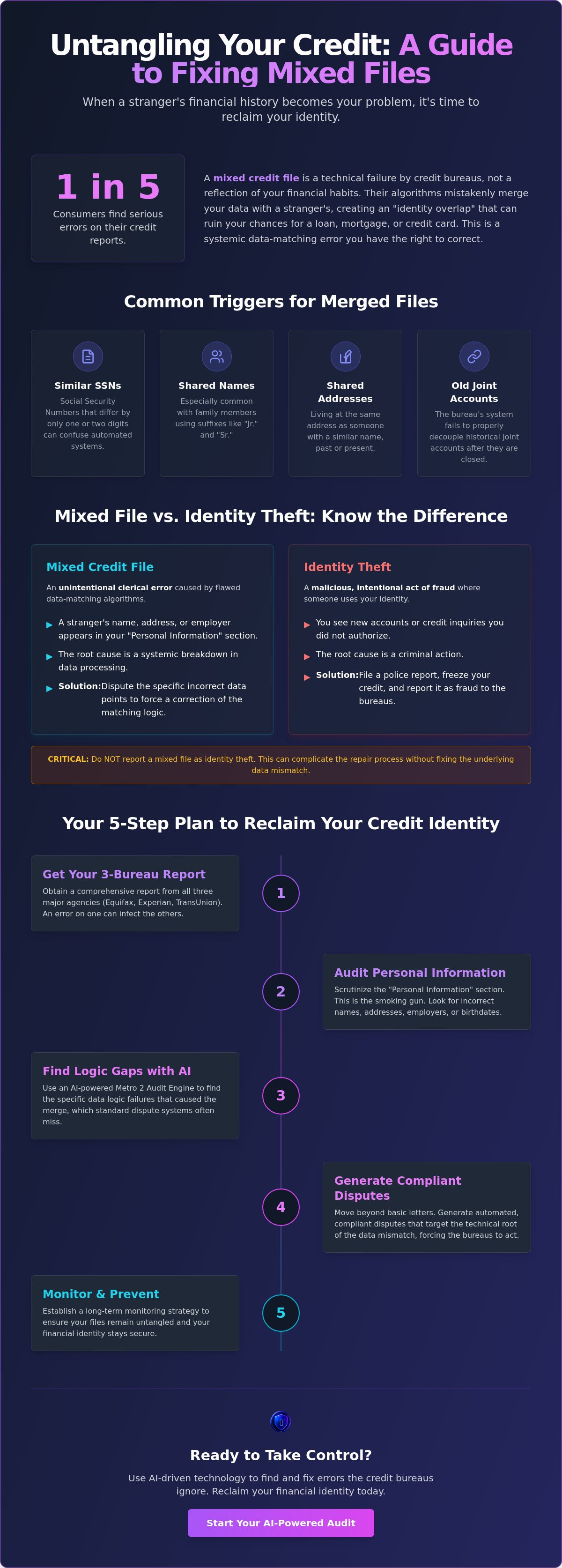
Step-by-Step Guide to Fixing Your Mixed Credit File
Executing a successful file separation requires a disciplined, sequential approach. You've already identified the logic gaps in your report using the audit techniques discussed earlier. Now, you must use that data to force the bureaus into action. Learning how to fix mixed credit files isn't about asking for a favor. It’s about providing the bureaus with the technical evidence they need to resolve their own internal matching errors. Follow these steps to move from a commingled report to a clean, accurate financial identity.
- Step 1: Obtain a fresh copy of your 3-bureau report. You need the most recent data available. Errors can shift or "re-merge" quickly, so ensure your audit is based on current records.
- Step 2: Use CreditVault.io to generate Metro 2 compliant letters. Our Metro 2 Audit Engine translates your report errors into the specific technical language bureaus prioritize. This ensures your dispute isn't dismissed by an automated scanner.
- Step 3: Submit your dispute. You can download and mail your letters via certified mail for a paper trail, or use a concierge service to handle the logistics for you.
- Step 4: Monitor for results. Bureaus typically have 30 to 45 days to investigate. Keep a close eye on your inbox for a "Notice of Dispute Results."
- Step 5: Verify the purge. Once you receive confirmation, check your "Personal Information" section immediately. Ensure every alias, address, and employer belonging to the other person has been permanently removed.
This systematic process is the most effective way to address how to fix mixed credit files without relying on slow, expensive litigation. You can start your automated dispute process here to ensure your letters meet the highest industry standards for accuracy.
Drafting the Perfect Dispute Letter
Your dispute letter must be bulletproof. Bureaus often use missing documentation as an excuse to ignore a request. You must include clear proof of your identity, such as a copy of your SSN card and recent utility bills. Most importantly, your letter should specifically demand a "file separation" rather than a simple deletion. Deletions are temporary; separation is permanent. To simplify this, use AI credit repair software to automate the drafting process. This ensures your letters contain the precise legal and technical citations needed to get past the bureau's first-level filters.
Handling Bureau Pushback
Don't be surprised if a bureau claims the information is "verified." This is a common automated response. When this happens, you must escalate. Use your Metro 2 Audit findings to point out that the data is unverifiable because it contradicts other verified points in your file. This creates a "factual dispute" that requires human intervention. If the process takes longer than a single round, consider transitioning from a weekly to a Monthly Subscription Plan at CreditVault.io. This allows for continuous surveillance of your file, ensuring that once the data is untangled, it stays that way.
Reclaiming Your Identity: Long-Term Monitoring and Prevention
Untangling your report from a stranger’s history is a significant win, but it isn't always a permanent one. Data is fluid. Because credit bureaus rely on automated algorithms to match incoming information, a "re-merge" can happen if the underlying data at the source remains corrupted. Learning how to fix mixed credit files requires a strategy that extends beyond the initial dispute. You must ensure that the technical triggers that caused the merge are neutralized at the creditor level to prevent the bureaus from algorithmically tethering you to that stranger again.
A successful file separation is a reset, not a shield. If a bank continues to report the other person’s data with identifiers that loosely match yours, the bureau’s system may eventually conclude they made a mistake in separating you. This cycle of "ghost data" returning to your report is one of the most frustrating aspects of the legacy credit system. Reclaiming your identity means moving from a defensive posture to one of active, tech-driven surveillance.
Fixing Errors at the Source
You must notify the original creditors reporting the stranger’s accounts. While the bureaus are responsible for the report, the banks are the "furnishers" of the data. Contact their compliance department and specifically request a "Data Purge" from their internal records. This ensures they stop sending the stranger’s information to the bureaus under your identifiers. Verify that your Social Security Number is correctly flagged in their system to prevent future loose-matching errors. If the creditor refuses to update their records, your Metro 2 Audit findings provide the technical proof needed to show their reporting is factually inconsistent.
The Power of Continuous Monitoring
Traditional credit monitoring services often fail to catch mixed files because they only alert you to score changes, not data-matching failures. A Weekly Subscription Plan provides the frequency needed to catch a re-merge before it impacts a loan application. By using the Metro 2 Audit Engine for regular "health checks," you can verify that your personal information section remains clean and that no "alias" names have returned. This proactive approach ensures that your file stays accurate and your financial autonomy remains intact.
Don't wait for a loan denial to discover your file has been compromised again. You have the tools to maintain a clean record and force the system to reflect your true financial life. Ready to untangle your report? Start your 3-day free trial with CreditVault today.
Finalizing your journey in how to fix mixed credit files means locking in your accuracy. Once you've purged the source data and established a monitoring routine, you can apply for mortgages or auto loans with the quiet confidence that your data belongs only to you. You’ve moved from being a victim of a systemic failure to a master of your own financial data.
Take Control of Your Financial Future
A mixed credit file is a technical glitch that has personal consequences. You've learned how to spot the red flags in your personal data and why manual disputes often fail against automated bureau systems. By shifting the focus from generic complaints to Metro 2 compliance, you've gained the leverage needed to separate your history from a stranger's mistakes. Understanding how to fix mixed credit files is about more than just a score; it's about reclaiming your autonomy in a complex financial system.
You don't have to navigate this technical maze alone. Our AI Credit Specialist, Mo, uses the Metro 2 Audit Engine to identify logic gaps and generate legally compliant disputes that demand results. It's time to stop answering for someone else's debt and start building your own future. Fix your mixed credit file with CreditVault.io-Start your free trial now.
Your financial identity belongs to you. With the right technology and a methodical approach, you can untangle the mess and move forward with confidence. You're now equipped to handle your own affairs with precision, logic, and speed.
Frequently Asked Questions
How long does it take to fix a mixed credit file?
The resolution process typically takes between 30 and 45 days once the bureau receives your dispute. Under the Fair Credit Reporting Act, bureaus must investigate your claim within 30 days. If you are dealing with a complex merge across all three bureaus, it may take multiple rounds of technical audits to ensure every "ghost" data point is permanently removed.
Can I sue the credit bureaus for a mixed credit report?
You have the right to sue a credit bureau under the FCRA if they fail to follow reasonable procedures to ensure maximum possible accuracy. Litigation is usually a last resort after you've provided proof of the error and the bureau has refused to correct it. While we provide the tools for how to fix mixed credit files, you should consult a legal professional if you intend to file a formal lawsuit.
Will a mixed credit file lower my credit score?
Yes, a mixed file almost always suppresses your score. If the person you are merged with has high credit card balances, late payments, or active collections, those items appear as your own. Even if their habits are decent, their debt-to-income ratio can negatively impact your ability to secure a mortgage or auto loan.
Is a mixed credit file the same as identity theft?
No, these are two different issues. Identity theft involves a criminal intentionally using your information for fraud. A mixed file is a clerical or algorithmic failure by the bureau to keep two similar consumer profiles separate. Reporting a mixed file as identity theft can lead to unnecessary fraud alerts that don't solve the underlying data-matching problem.
How do I prove a credit account is not mine?
You prove an account isn't yours by providing objective identity documents and pointing out logical impossibilities. Submit copies of your Social Security card and birth certificate. Use a Metro 2 audit to highlight accounts opened before you were 18 or birthdates that don't match your own. These factual contradictions force the bureau to acknowledge the data mismatch.
What happens if the credit bureau refuses to separate my file?
If a bureau refuses to separate your file, you must escalate the dispute with more specific evidence. Use the Metro 2 Audit Engine to identify the exact logic gaps they ignored. You can also file a formal complaint with the Consumer Financial Protection Bureau (CFPB) to bring regulatory pressure on the agency to follow the law.
Can CreditVault fix a mixed file automatically?
CreditVault automates the most difficult parts of the process: the audit and the dispute generation. Our AI Credit Specialist, Mo, analyzes your reports to find crossed data points and generates Metro 2 compliant letters for you. You then submit these letters to the bureaus to trigger the manual file separation process required by their internal systems.
Do I need a lawyer to fix a merged credit report?
You don't need a lawyer to dispute a merged report. The law gives you the right to handle your own credit affairs directly with the bureaus. Many consumers find that using advanced technology to identify technical errors is a faster and more empowering way to handle how to fix mixed credit files than paying for expensive legal representation.